
April 7, 2025 · Antonio Rodriguez
How GlueOps Uses GlueOps to Cut Our Cloud Bills in Half
Cloud-Agnostic Infrastructure for Cost Management and Flexibility
From “Or” to “And”: Redefining Infrastructure Tradeoffs
We started GlueOps because we love open source: from the freedom to deploy projects anywhere, to the opportunity to be part of communities and contribute back, to not being beholden to a single vendor’s decisions. We’ve built our platform to offer the same features, capabilities, and tools regardless of underlying servers: whether hyperscaler, on-premises, or metal provider.
Originally, we thought about our base-infrastructure choice as an “or” decision. Increasingly, we’ve seen many benefits of an “and” approach and are actively using multiple providers simultaneously.
One significant benefit of embracing this strategy is dramatic reductions in our infrastructure costs without sacrificing performance or developer experience.
We realized we were paying a premium for hyperscaler cloud services that didn’t benefit a number of our workloads.
Using multiple providers with cloud-agnostic infrastructure slashed our cloud costs by over 50%. 99.99% reliability is essential for the services we deliver to customers, but not for the staging environments we use for less than 10 hours a week.
Beyond Cloud-Native: Becoming Compute-Agnostic
A cloud-native approach to infrastructure laid the foundation for how our industry builds and runs applications today. This trend is increasingly intersecting with workload repatriation, as organizations grapple with hyperscaler lock-in and high costs compared to alternative compute options. We’ve discovered that cloud-native practices and projects apply just as effectively to on-prem and metal deployments.
With GlueOps, we prioritize:
- Seamless deployment across any compute provider, such as AWS, Google Cloud, Azure, Heymann, Hetzner, and even servers under our desks.
- Rapid migration between providers (15 minutes or less for stateless applications).
- Eliminating dependencies on proprietary vendor features.
Matching Workloads and Providers
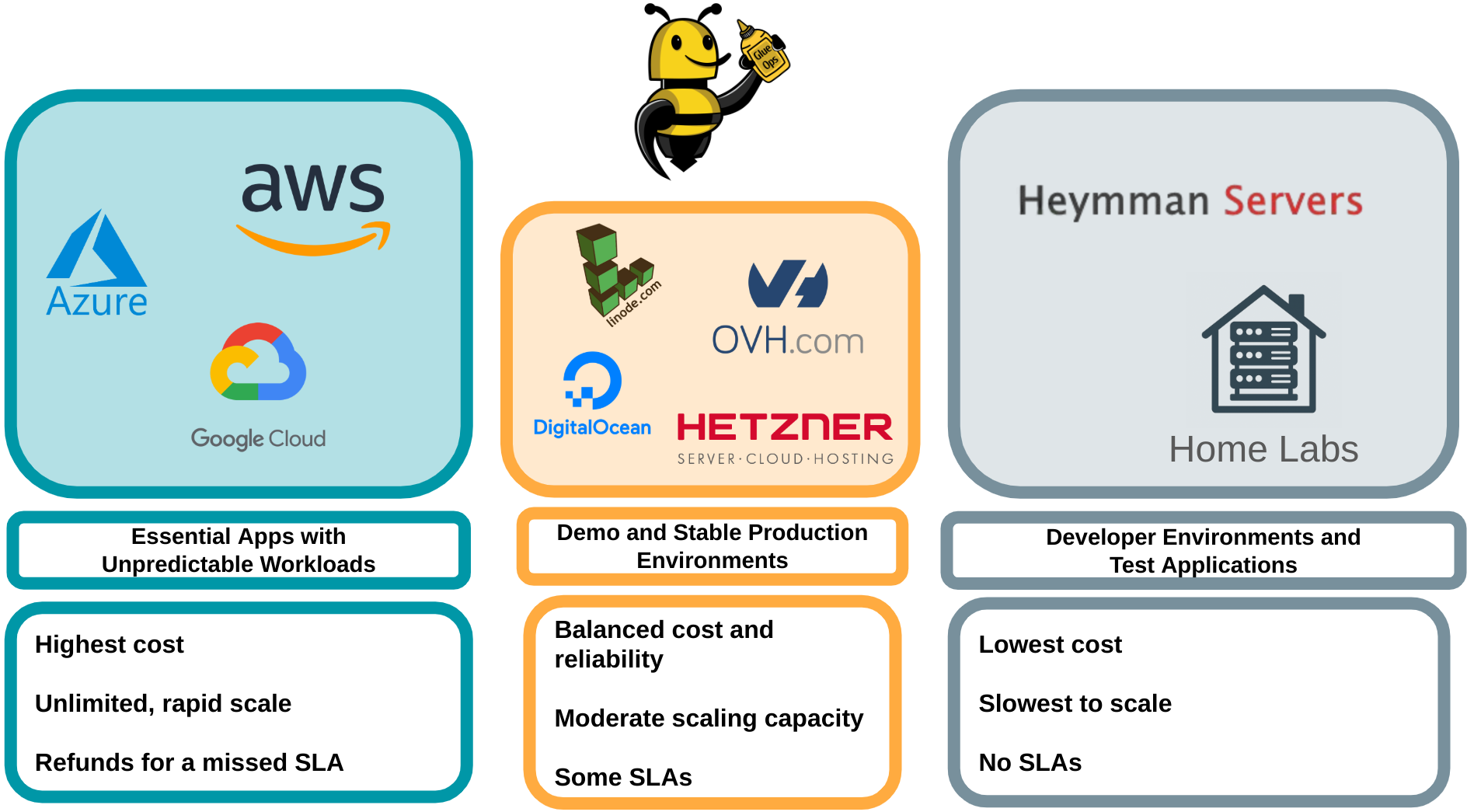
As we examined our infrastructure, we leveraged industry insights into workload repatriation, a growing trend for businesses reconsidering their cloud strategies.
We looked for:
- Stable workloads that don’t require rapid scale up or scale down.
- Environments that can handle brief downtime.
- Predictable and consistent usage patterns.
If you have workloads that are stable, predictable, and don’t require immediate scaling, hyperscalers might be overkill.
Creating Efficiencies: Balancing Hyperscaler Cost and Benefits
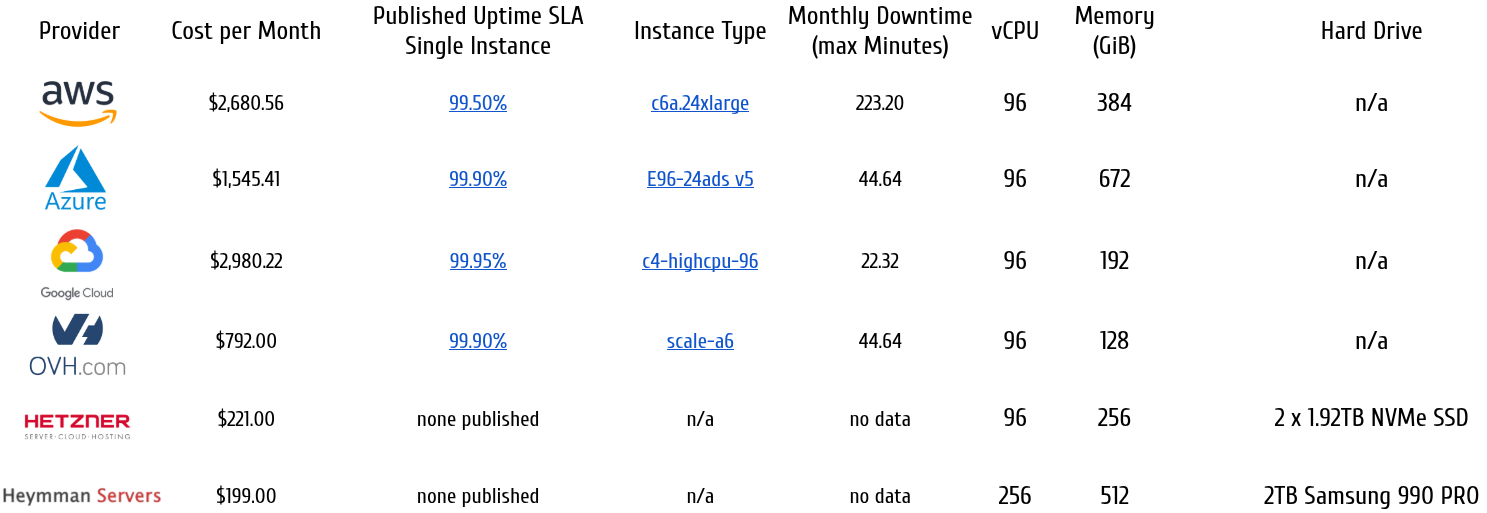
Like many startups, GlueOps developed the first versions of our platform by leveraging the generous cloud credits provided by hyperscalers. However, as our platform grew, so did our expenses. By shifting our development and demo environments to metal providers like Heymann and Hetzner, we realized substantial savings:
- Metal provider servers are priced at approximately 10% of comparable AWS offerings.
- Our total infrastructure spend dropped by more than 50%, even considering our use of reserved instance pricing.
- Spinning up new environments takes about 15 minutes – minimizing the impact of hardware failures (of which we’ve had none so far).
Embrace Open Source, Avoid Lock-In
Our move wasn’t without its lessons. To achieve true cloud agnosticism we:
- Commit to open-source solutions from the start: CNCF projects and Kubernetes are essential.
- Weigh the tradeoffs of using proprietary tools from hyperscalers that provide short-term convenience but limit long-term flexibility.
Tempting as hyperscaler tools are, lock-in costs far more in the long run than the convenience gained upfront.
Cloud-Agnostic Infrastructure is an Operational Advantage
Infrastructure strategies don’t have to be rigidly “only this cloud,” “cloud-only,” or “on-premises-only.” The strategic advantage is in flexibility:
- Choose the best hardware at the optimal price without losing features.
- Avoid vendor lock-in by relying on open source and CNCF technologies.
The industry is shifting, and GlueOps is proof: you don’t need to choose a single cloud, or even a cloud at all, to benefit from CNCF practices.
Start agnostic and stay flexible!
GlueOps is a cloud-agnostic container delivery platform that leverages the best of open source to enable engineering teams to build and run workloads across any provider without vendor lock-in.
Check us out: https://www.glueops.dev,
Speak with us: https://schedule.glueops.dev/
Our work is publicly available: https://github.com/GlueOps